
Moving The Earth with Half a Gauze
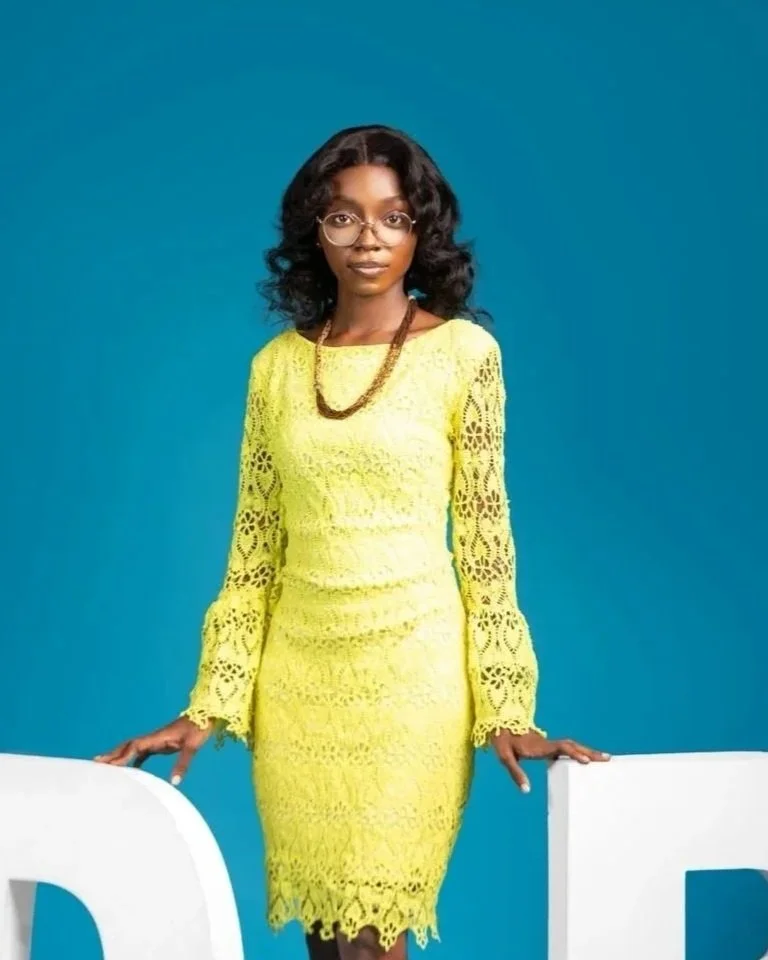
Akua Mmera Gyedu
Congratulations to Akua Mmera Gyedu! Akua is an alumna of the 2025 AMPATH Ghana Medical Student Exchange Program and a recently graduated medical student from the University for Development Studies (UDS). Akua received an Honorable Mention in the 2026 CUGH Global Health Reflection Essay Contest for her essay, Moving the Earth with Half a Gauze. Read her award-winning reflection and learn how global health student exchange programs create lasting impact.
Anyone could have aced the interview for the exchange program, yet somehow I was the one chosen. Everyone was watching closely to see what I would do with the opportunity I had been given. At twenty-four, with an American visa in hand, I had no clue how I would navigate this journey.
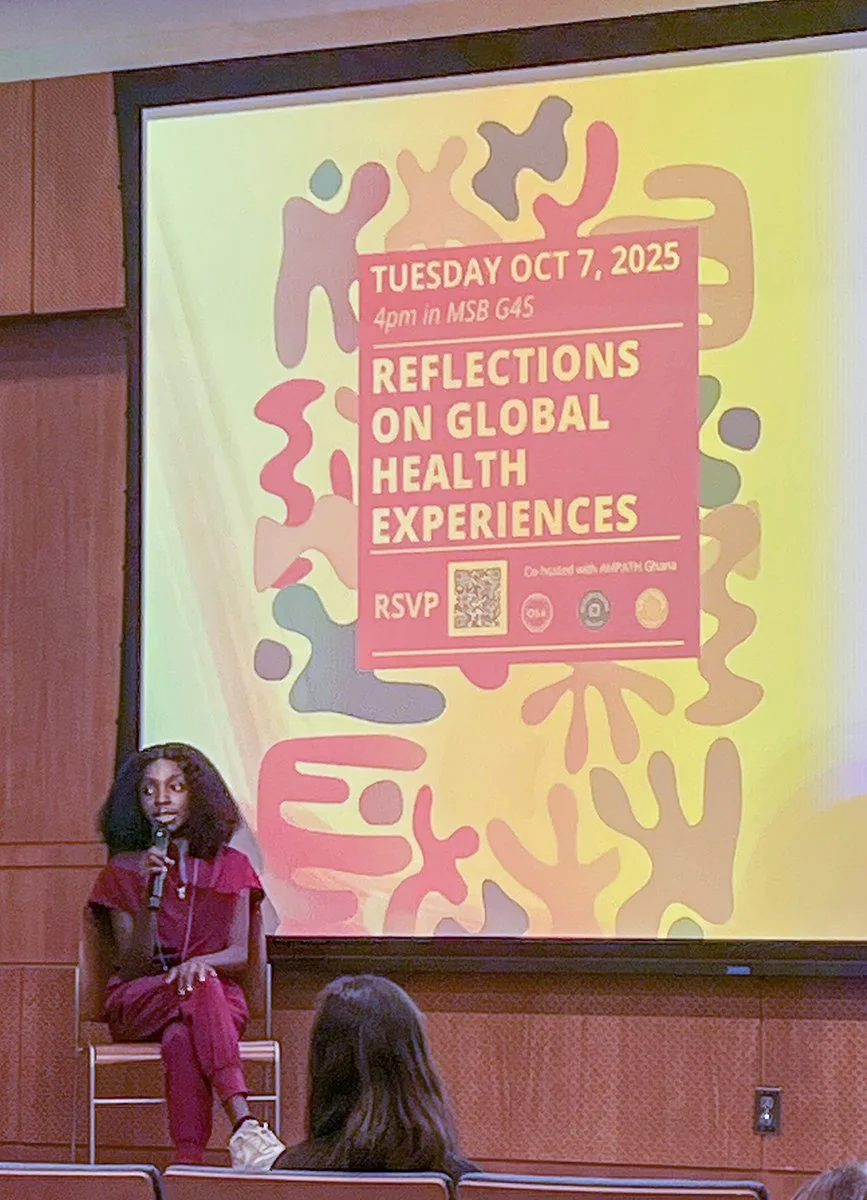
Akua presenting her reflection
Archimedes once said, “Give me a lever long enough, and a place to stand, and I will move the earth”. This trip was my lever and everyone back home was waiting for me to move the earth. I was overjoyed to see Times Square and the bagels were always worth the long Sunday morning queue, but I could not shake the feeling that I did not belong. My accent announced me before I opened my mouth. For someone praised back home for my eloquence, I wondered for the first time if my English was broken.
On the wards, I tried my best to seem competent when it came to working with the various machines, but truth be told, I had never even seen half the machines I was working with before! I had gone through my entire medical training without ever seeing an MRI machine. It was mind-blowing just how fast-paced the healthcare system was. Laboratory results which I was used to waiting hours on end for could now be obtained in a matter of minutes. I had been put in a never-ending whirl, and what kept me spinning was pure and unfiltered envy.
That was what consumed me while I watched intently as one pair of gloves was used per patient and then hurriedly tossed into the bins or when the rapid response team saved a woman from a heart attack in minutes. I remember the moment I wanted to rip that hospital from its place and pack it –its efficient corridors, machines, and stocked cabinets –into my suitcase and smuggle it back home. I wanted to take the zeal in the eyes of the healthcare workers and pour it into the doctor back home who had to cut the last roll of gauze in two halves so the next shift had something left. More than that, I wanted to steal the vast resources and hand them over to younger me bent over her phone watching YouTube videos of procedures not accessible in her country. I ached to give her the simulation lab I stood in learning medicine with equipment I knew would probably be the last time I laid eyes on. I wanted answers because people back home trusted me to return with them; instead, I stood panicked and diminished by what neither I nor those people had ever possessed. Times without number, I thought of screaming in the middle of the ward, “Do you all have any idea how privileged you are?” But I did not do that. I kept all of my envy hidden inside of me instead.
One evening at a dinner, I spotted a man a few tables away. He was in a specific traditional attire men wore back home. He was a shard of familiarity in a foreign room. I watched him closely. He laughed proudly and loudly, spoke with an unapologetic accent, and did not try to belong. Seeing him occupy the room by simply being himself struck something loose inside me. I realized I already had a lever: not the foreign technology and systems I coveted, but my own voice, my training and the moral urgency and health disparities that had driven me into medicine in the first place.
From that evening on, I stopped consciously editing my speech for other people. I spoke in the cadence I knew, and I paid rapt attention: to how teams ran rapid responses, how they assigned clear roles in emergencies, how simulation drills shortened reaction times. Medicine, I found, is and always will be a universal language. The principles I learned back home held true across borders –triage, communication and protocol –even if the equipment did not.
I returned home after five weeks. The contrast was sharp, immediate and brutal. Two weeks later, a friend’s mother died from a stroke. They had searched the city for hours for a CT scan; and when they finally found one, the hospital was full to capacity. I mourned for her, and for every preventable death that scarcity had made inevitable. I also mourned the simpler potential loss: the fact that I, a doctor, could drop dead at any second because the hospital may not have the equipment needed to save me.
I still have not completely figured out yet how to move the earth. I cannot promise that the next doctor in my hospital will never have to cut a roll of gauze into two halves but I refuse to let scarcity define us and the stories we tell ourselves. What I can do – what I have already begun doing – is small but practical and consistent. Being privileged to have experienced far more advanced and efficient healthcare, I write and speak about what I saw. I educate colleagues on emergency responses that borrow the simulation techniques I observed. I help implement checklists that clarify team roles during resuscitation. These are not grand gestures, but they are steady acts of maintenance that go a long way to make systems resilient, especially in the face of challenges.
The work is slow and frustrating. It is the labour of translation and persistence: it is arguing for simulation drills in a schedule already full of patients. It is taking a protocol learned in a hospital with spare gloves and making it function where gloves are few. And yet, the lever Archimedes promised need not be iron and long; it can be a persistent insistence that things can change from what they are now. It is this insistence I carry now. I may not have moved the earth yet, but I have begun to move the place where I stand. I am becoming the lever now.