
More Than a Rotation: University for Development Studies Students Reflect on Off-Campus Clinical Training in Ghana
In the lively town of Techiman, about a 3.5-hour drive (257 km) from Tamale, Ghana, Holy Family Hospital has become more than just a site of learning--it has transformed into a hub of mentorship, teamwork and purpose. As a strategic initiative within the AMPATH Ghana partnership, nearly 170 medical students from University of Development Studies (UDS) were placed in this peri-urban health facility to undertake off-campus clinical training (OCCT). They engaged with patients and families facing significant health challenges, and their learning went far beyond textbooks and procedures.
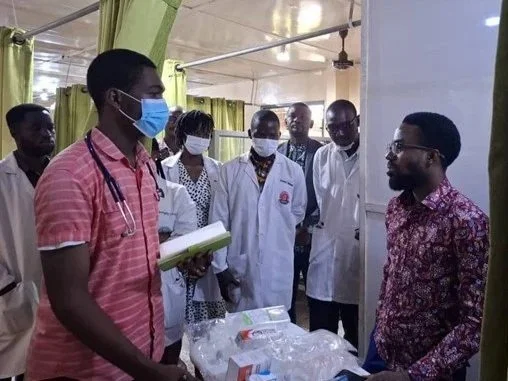
UDS students and preceptor at Holy Family Hospital in Techiman, an OCCT site, participating in ward rounds and case reviews
Learning by Doing, Growing by Serving
The OCCT program complements clinical teaching at Tamale Teaching Hospital, and aims to bridge the gap between academic knowledge and frontline practice. For two months, students work alongside seasoned clinicians and participate in ward rounds, surgeries, and emergency cases that emphasize critical thinking, clinical ethics and communication skills. From taking patient histories to assisting in procedures, students are not only learning but also actively contributing to healthcare delivery. Mentorship and supervision are provided by health professionals from the participating hospitals, Holy Family Hospital in the Bono Region, Wa Regional Hospital in the Upper West Region, and Bolgatanga Regional Hospital in the Upper East Region, under the direct supervision of UDS staff.
Crucially, UDS, as the program originator, and AMPATH Ghana are committed to continuous quality improvement and adaptive management of OCCT. AMPATH Ghana specifically supports this effort through program evaluation, conducting essential feedback-gathering activities like focus group discussions with medical students and preceptors. This systematic evaluation ensures that the OCCT program remains relevant and effective in achieving its goals.

Prof Stephen Tabiri, Dean of UDS School of Medicine
As Ghana works toward strengthening its health workforce and achieving universal health coverage, experiences like OCCT provide a realistic lens through which future doctors can see their role. The OCCT initiative provides high-quality training for medical students and, at the same time, works to increase the numbers of doctors providing high quality care in rural areas of Ghana. The men, women, and children living there have access to a very limited number of doctors compared to those living in the southern part of the country, causing them to suffer disproportionately from preventable disease and premature death.
The Dean of UDS School of Medicine, Prof. Stephen Tabiri, shares, "Training in environments like Techiman is essential. It shapes not just the competence, but the character of our future health leaders.”
Students at Techiman Holy Family Hospital quickly discovered they weren’t just there to fulfill a requirement; they were stepping into a structured environment where growth was intentional and support was constant.
A Culture of Mentorship and Excellence
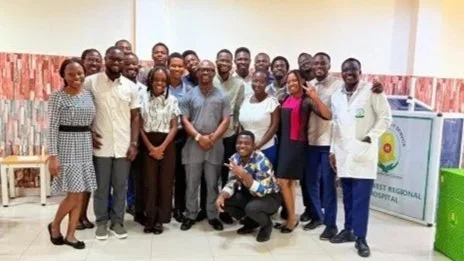
UDS students at Bolgatanga Regional Hospital, an OCCT site
Dr. Ohene Adjei, a seasoned physician specialist at the facility, played a key role in guiding the students’ development. His mentorship extended beyond the hospital walls, encouraging students to reflect deeply on their responsibilities as future physicians. "We don’t just train hands, we shape minds and attitudes," Dr. Adjei remarked. "It’s important for students to learn how to adapt clinical reasoning to real-life situations where guidelines don’t always match the context."
At its core, OCCT is more than a program, it’s a shared commitment to building a future-ready health system. Over the next 3 years, the program plans to expand to more Regional and District Hospitals accredited by UDS and the Ghana Medical & Dental Council and include 700 additional students. Prof Tabiri says this initiative is an essential part of the government’s agenda of providing universal health care to all Ghanaian citizens “irrespective of where you live.”
As one UDS student reflects: "I came here to complete a rotation. I’m leaving with a renewed passion for medicine."